About / Indigenous

Indigenous ways of knowing are not background decoration for this project. They are the educational foundation: a set of rigorous, relational learning practices that help people slow down, reflect, and evaluate information with responsibility to community, place, and the real world.

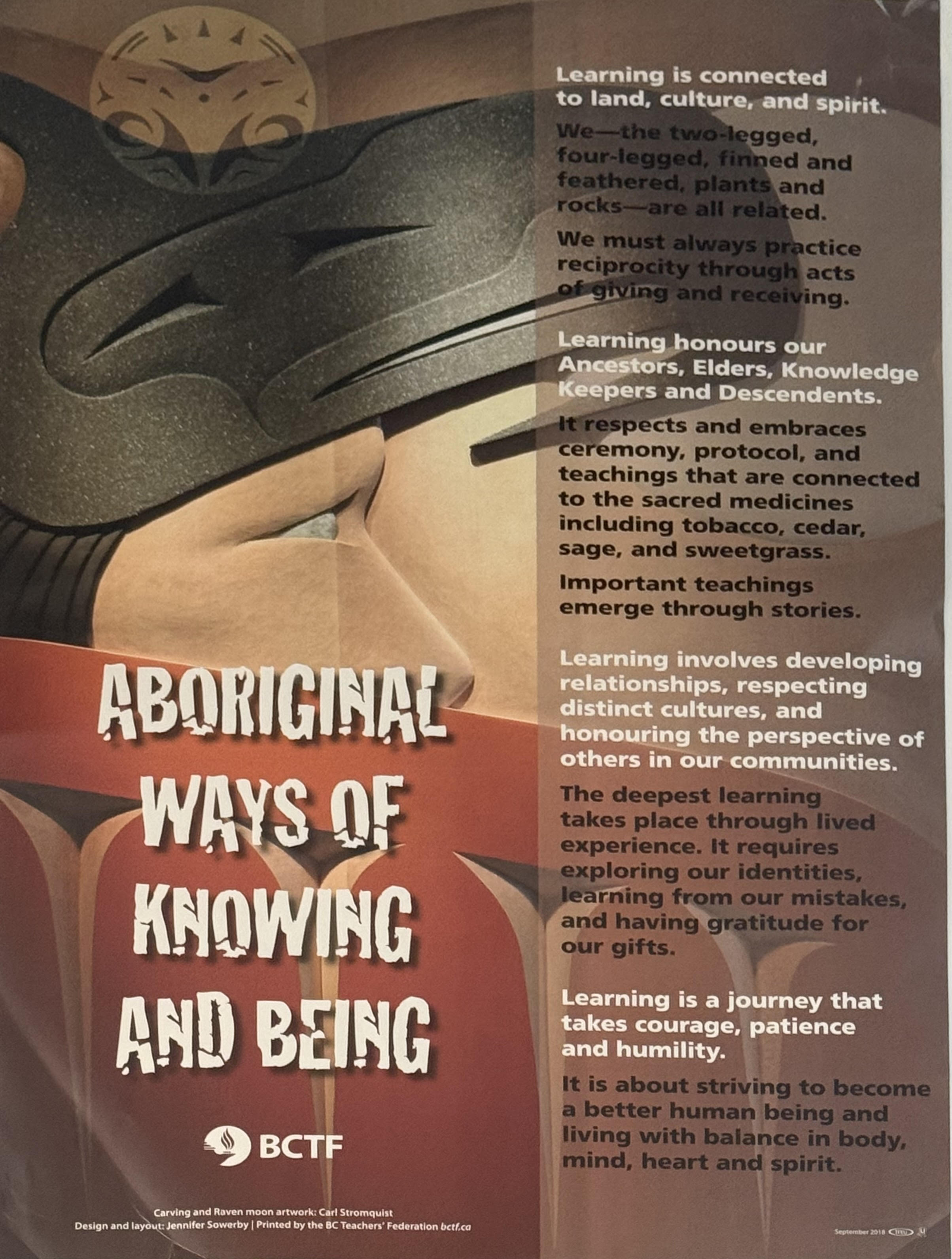
Principle poster for Indigenous ways of knowing

What Indigenous ways of knowing includes

Indigenous ways of knowing describe how knowledge is built, shared, tested, and lived, not only what appears on a page. They are interconnected learning methods that treat understanding as something that grows through relationship, experience, guidance, and accountability.

Because these approaches are holistic, they also change the pace of learning. Instead of optimizing for instant answers, learners are invited to observe carefully, participate fully, listen before speaking, and connect ideas to consequences for people and places.

Stories, dialogue, and collective sense-making

Oral storytelling and talking circles are not "extras." They are structured ways to transmit knowledge, preserve nuance, and ensure that learning happens in ethical relationship with others. They also model a crucial habit for the AI era: learning through patient dialogue rather than through the first plausible sentence a machine offers.
Observation, participation, and learning by doing

Observation and participation treat the learner as someone who gains knowledge through engaged experience, watching patterns, trying skills, adjusting based on feedback, and reflecting on what happened. Learning by doing connects ideas to outcomes, which helps learners evaluate claims against reality rather than accepting outputs that merely sound organized.

Land-based learning and living systems

Land-based learning grounds knowledge in place. It asks learners to understand context: seasons, ecosystems, responsibilities, and relationships. That context matters for AI literacy because so much online information is decontextualized, presented as universal when it is actually partial, biased, or generated without accountability to a real community.

Reciprocity, responsibility, and intergenerational teaching

Knowledge is often understood as something held in relationship: responsibility to others, reciprocity with the land, and continuity across generations. Intergenerational teaching ensures that learning is not only individual achievement but a shared practice with long horizons, an important counterweight to AI tools that optimize for speed and novelty.

Elders, trusted knowledge holders, and guided learning

Learning from Elders and trusted knowledge holders centers ethical guidance and earned expertise. This is not the same as treating any fluent output as an expert. It reinforces a habit educators need in AI settings: distinguish between an authoritative voice and a system trained to imitate authority.

Reflection, relational thinking, and knowledge tied to lived experience

Reflection turns experience into understanding. Relational thinking asks how ideas connect to people, histories, and obligations. Together, these approaches treat knowledge as something verified through life and community, not only through text that "looks correct."

Ways of knowing poster

Why this approach works

AI-era information problems are not only technical; they are habits of attention, trust, and judgment. Indigenous ways of knowing strengthen the human capacities that evaluation requires.

Slowing passive acceptance

Many AI interfaces reward speed. A relational learning approach interrupts that automatic reflex by building classroom norms around listening, questioning, and returning to evidence, not only consuming content.

Questioning, reflection, and comparing to lived reality

Learners practice comparing claims with lived experience and with community knowledge. This does not mean rejecting technology; it means refusing to treat fluency as proof.

Multiple perspectives instead of blind acceptance

Discussion-centered learning values more than one voice and more than one way of knowing. That pluralism is a direct counter to filter bubbles, persuasive defaults, and synthetic media that present a single "seamless" story.

Judgment over mere recall

The goal is not memorizing outputs but building judgment: when to trust, how to verify, who to consult, and what responsibility accompanies sharing information.

Critical engagement with AI rather than dependence

Students can learn to use AI as a tool while still understanding limits, error modes, incentives, and manipulation risks. The pedagogical stance is guided experimentation and accountable inquiry, not outsourcing thinking.

Trust, guidance, and real-world verification

Reconnecting learning with trustworthy human guidance and real-world verification protects learners from the fantasy that information is harmless if it is "personalized" or convenient.

Supporting voices

The following scholars and educators are highlighted here because their work helps clarify why Indigenous education and Indigenous knowledge systems matter in schools today, and why approaches rooted in Indigenous ways of learning should be understood seriously, respectfully, and accurately, especially as new technologies reshape classrooms.

Susan Hill

Director, Centre for Indigenous Studies; Associate Professor, University of Toronto

Her scholarship emphasizes that knowledge is relational and tied to community. For education, that means Indigenous knowledge systems cannot be reduced to isolated facts: they must be approached as living frameworks that shape how learning happens, who is responsible to whom, and how understanding is carried ethically across relationships.

Wenona Hall

Associate Professor and Chair, Indigenous Studies, Simon Fraser University

Her work underscores that meaningful Indigenous education reconnects learners with real-world context. In an AI-saturated information environment, that reconnection is a form of protection: learners practice grounding claims in place, people, lived experience, and accountability, not only in algorithmic outputs.

Chelsey Armstrong

Assistant Professor and Undergraduate Chair, Indigenous Studies, Simon Fraser University

Her research brings forward how humans exist within interconnected systems, ecological, cultural, and historical. For schools, that perspective reframes technology: AI outputs are not neutral truth dropped into a vacuum; they land inside relationships, histories, and ongoing responsibilities that Indigenous knowledge systems have long taken seriously.

Grant Gillies

Former Indigenous Director; IB and BC curriculum Geography teacher at REMSS

His educational stance reinforces a classroom truth that policy conversations sometimes miss: Indigenous ways of knowing are not automatically transmitted through AI tools. If Indigenous learning is treated as a serious pedagogy, it requires intentional teaching, respectful engagement, and systems that preserve and support Indigenous knowledge rather than replacing it with whatever is easiest to automate.

Curriculum grounding

The IndigiAI proposal takes consideration from official Indigenous Knowledge and Perspectives curricular materials. That grounding is meant to signal that the project is aligned with existing educational discourse, not invented as a standalone slogan, and not separate from the realities of classroom implementation and system-level responsibility.